
Muhlenberg Township One-Person Record Coverage
There is no single public roster for every Muhlenberg Township resident. A responsible one-person check uses the custodian whose record fits the question. The Berks assessment card can identify the assessed owner tied to a parcel and keeps the site location separate from the mailing address. A recorded deed supplies party roles and a title link. The Register of Wills index can supply estate or marriage context, while the Pennsylvania Judiciary portal supplies public docket-sheet context. Each source has gaps, so a match should be confirmed before it is treated as the right person.
| Record | Question It Can Answer | Custodian or Search Route | Access Boundary |
|---|---|---|---|
| Assessment property card | Who is listed as assessment owner and what parcel is involved | Berks Property Records Search | Current card, not a household roster |
| Recorded document | Party role, recording date, and property description link | Berks Recorder Cloud Search | A recorded party is not automatically a current resident |
| Estate or marriage index | Public case, life-event, or family-history context | Berks Register of Wills | Older estate files require office contact |
| Public court docket | Case identifiers, parties, dates, and available status | Pennsylvania Judiciary Case Search | Some matters are excluded from public display |
| Vital record | Eligible certified record or historical index by era | PA Vital Records | Recent certificates are restricted |
Begin with the narrowest record key. An address or UPI points first to the property card. A court question belongs in the docket portal. An older family-history question may fit the estate index or an archival vital record. A personal voter-status tool is for a person checking that person’s own registration, not a public name browser. Note: a record name, mailing field, or public docket entry needs independent confirmation before it is tied to a particular Muhlenberg Township resident.
Verify a Muhlenberg Township Resident Across Records
To look up a resident accurately, compare small facts that two official sources share. For a property-related question, the useful combination is assessment owner name, Muhlenberg Township municipality, UPI, sale date, and the recorded party or legal description. Do not turn a site location into a mailing address, or a mailing address into proof that a person lives at the parcel. For an older trail, compare spelling variants with a directory or census year and then test the result against a public estate, marriage, or death record where appropriate.
- Search the owner name, street address, or UPI in the Berks assessment portal. Save the municipality, site location, ownership label, and sale or deed reference exactly as displayed.
- Use the cited instrument number or book and page in the Recorder search. Compare the grantee or grantor spelling, recording date, and legal description with the parcel data.
- When a public court or estate record is relevant, search the name with a county, date, or case filter. Treat a matching name as a candidate until independent details agree.
- Ask the appropriate custodian for a specific public document when an index alone cannot answer the question. Include the name, approximate date, division, and copy or certification choice.
The same-name trap is common in a countywide search. A surname or a street alone can join unrelated people. Record why the identifiers match, and do not infer a family relationship from shared geography or a last name.
- Docket
- A court’s chronological case sheet, showing public case events and identifiers rather than every underlying paper.
- Index and image
- An index helps locate a record by fields such as name or date. An image is the scanned record itself, when the custodian makes it available.
- Certified copy
- A copy the custodian certifies as a true copy of its record. Availability and fees depend on the particular office and record type.
Search UJS for a Muhlenberg Township Resident
The free Pennsylvania Judiciary Web Portal Case Search is the official public docket-sheet route for Berks County courts. Its own guidance favors minimum criteria: participant first name, last name, and county, followed by filters. That avoids needlessly broad searches and makes it easier to compare names. Search results are docket information, not a statewide criminal-history report and not proof of a person’s current address.
| Participant fields | Last name, first name, date of birth, participant role, and organization name where applicable. |
|---|---|
| Place and court filters | County, judicial district, MDJS court office, municipality, city, state, and ZIP fields are exposed for appropriate search modes. |
| Case filters | Docket, citation, complaint, incident, OTN, filing-date range, type, category, status, judge, and arresting-agency fields are available as the selected mode allows. |
| Public result inventory | Available sheets can show docket and court identifiers, category or status, parties and roles, filing and event dates, calendar activity, and public charge, financial, or disposition information. |
A Berks Clerk of Courts page is the criminal Common Pleas custodian route for this one-person verification step.
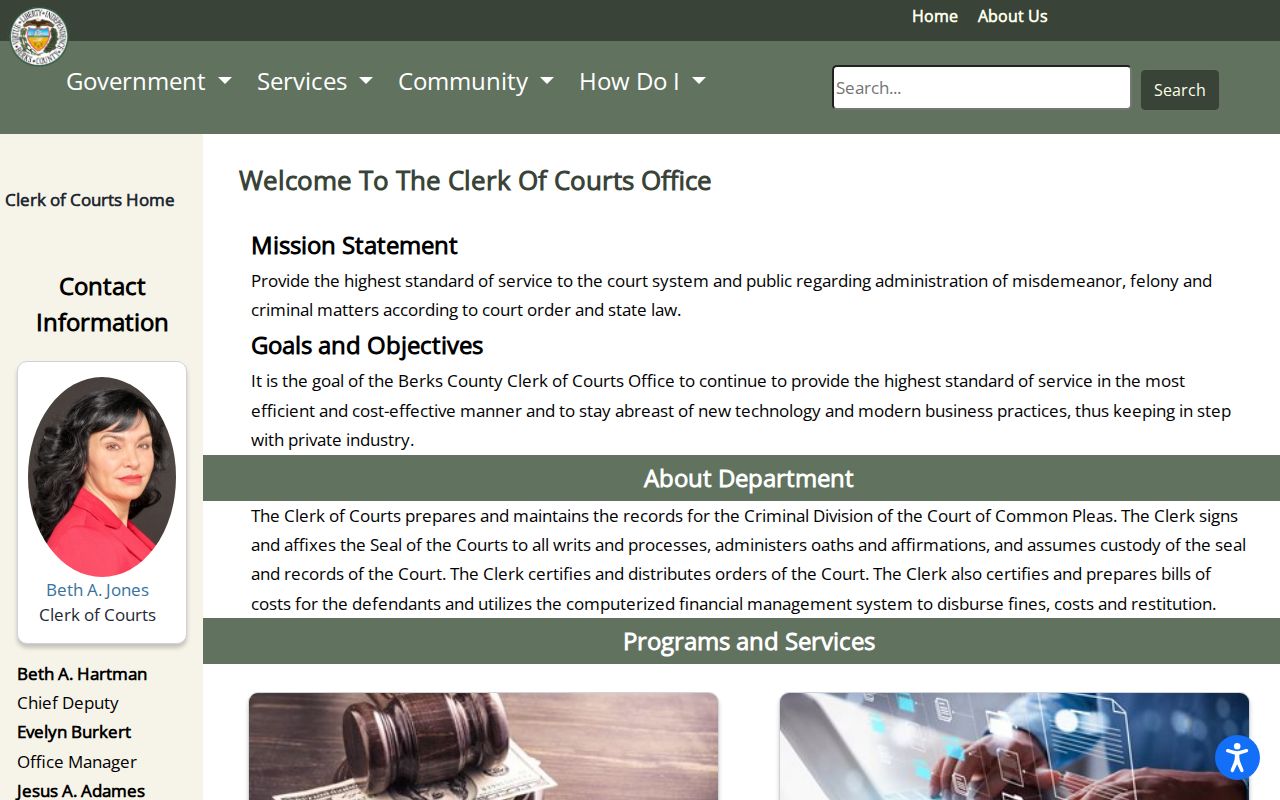
The Clerk is the right follow-up for a public criminal Common Pleas document that is not supplied by a docket sheet.
A no-result screen has a firm limit. Juvenile, sealed, expunged, pending-expungement, limited-access, and some civil Common Pleas matters may not appear. Magisterial docket information can also disappear after the paper record is or should be destroyed under the retention schedule. A missing web result cannot prove that no court matter exists.
Berks Custodians Behind Resident Lookup Results
Use the custodian that holds the division of record instead of sending a broad request to a general county inbox. The Clerk of Courts keeps criminal Common Pleas records. The Prothonotary keeps civil, family, equity, judgment, lien, arbitration, and appeal filings. Court Administration and the Magisterial District Justice offices have their own open-records route. A request is more usable when it identifies the docket number, party, division, approximate date range, particular document, delivery preference, and whether certification is needed.
The Berks Prothonotary is the civil and family filing custodian.
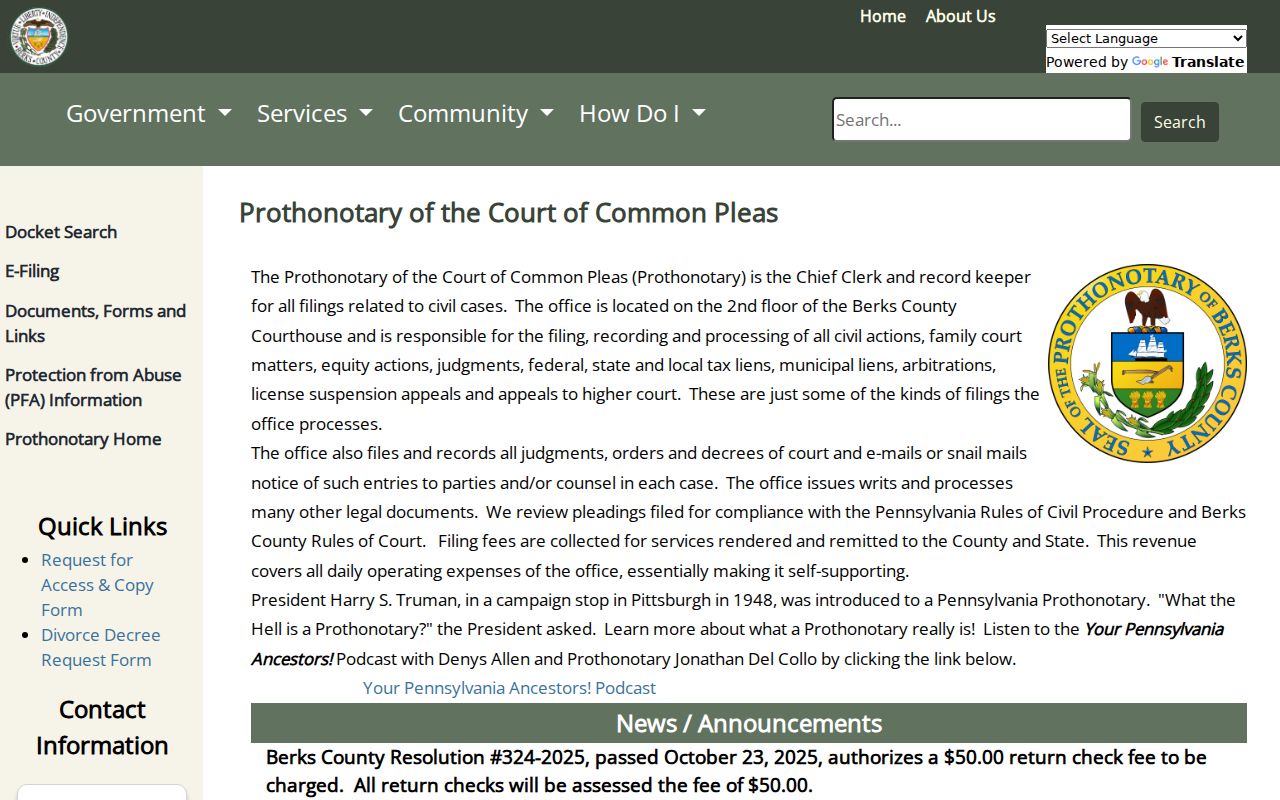
Its office-specific request path matters because a public docket summary does not promise every filing image or certified copy.
For Court Administration or Magisterial records, the county identifies its Court Open Records Officer at 633 Court Street, seventh floor, Reading, with 610-478-6208 and Courtopenrecordsofficer@berkspa.gov. The Clerk and Prothonotary each use separate routes. That separation preserves the record’s custody and helps a requester ask for an existing document rather than an answer the office does not keep.
Estate Trails in a Muhlenberg Township Search
The Berks Register of Wills genealogy index is especially useful for legitimate heir and family-history research. The office reports more than one million records, compiled over eight years by staff and volunteers. Its public route permits guest access for the 1992-present document path. Search by name, case number, or date, open the case details, select a document, add the blue document link to the print queue, and pay only if a download is needed. Estate files before 1992 require direct contact with the office.
The Register’s genealogy page supplies the source for this Muhlenberg Township estate step.
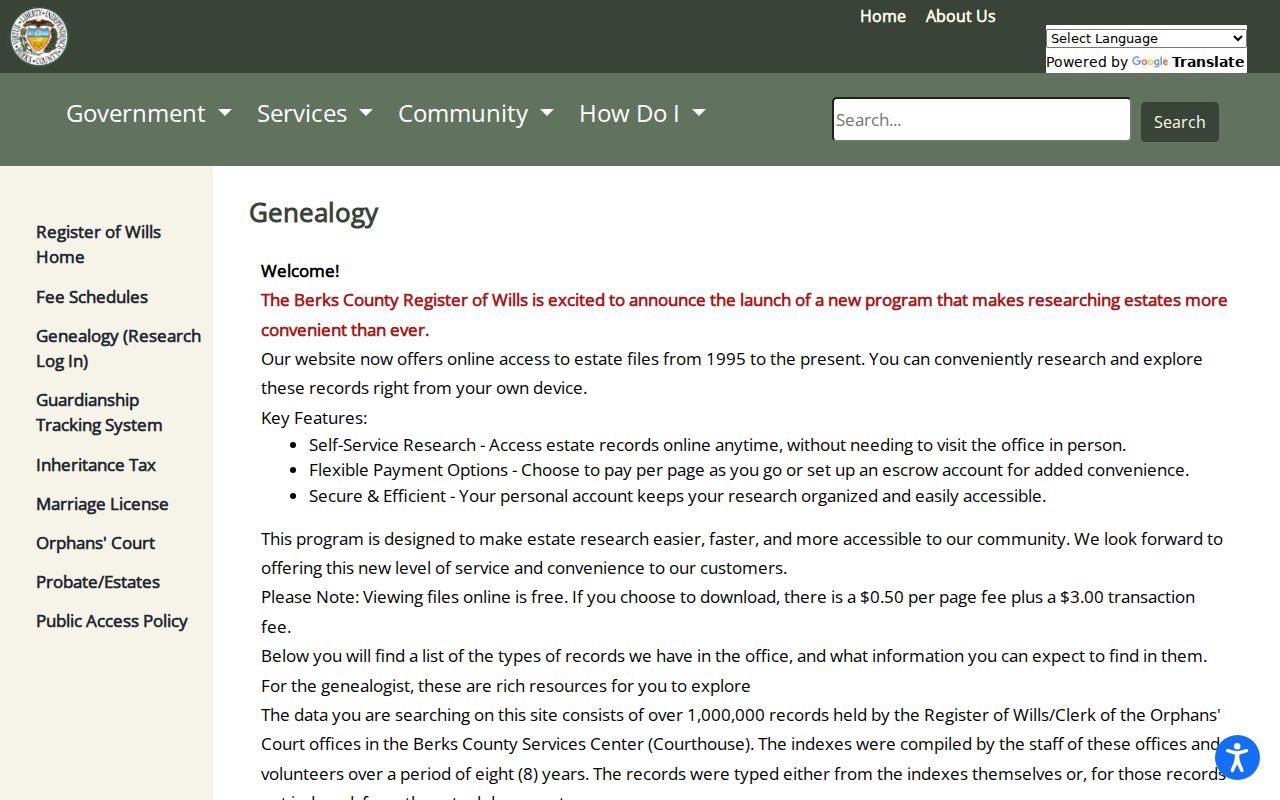
An estate result can identify a decedent, fiduciary, heir context, dates, and file identifiers, but every person named still needs corroboration.
Marriage material has a different historical value. Berks records from 1885 forward include applicant details and ceremony information, while City of Reading marriages cover 1876 through 1884. Those series can help place a life event in time. They should not be treated as a current residence list, and adoption-related material may have narrower access rules.
Vital Record Routes for Muhlenberg Township Residents
Vital access changes with the year and the requester’s eligibility. The Pennsylvania Division of Vital Records holds statewide birth, death, and fetal-death records from 1906 forward. A certified birth or death certificate has a $20 base fee, and the state’s online ordering route adds a service charge. Recent certificates are not a public name-search tool. Birth records become public after 105 years and death records after 50 years, then move to the State Archives under the Vital Statistics Law.
The Pennsylvania birth-certificate service explains eligibility, identification, and ordering channels.
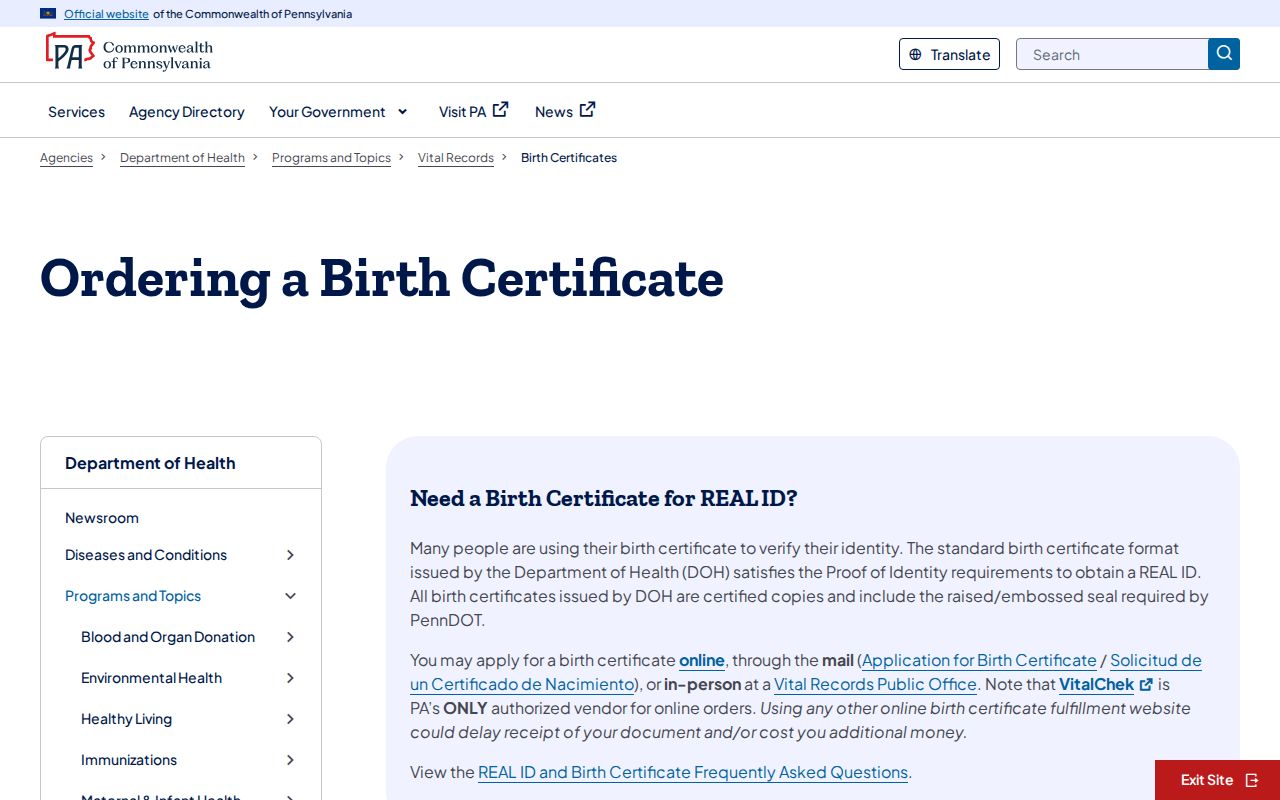
For earlier work, Berks county birth and death registers and the State Archives chronology may supply the more fitting historical path. The Register’s genealogy listing identifies county birth and death registers for 1894 through 1906 and City of Reading birth records for 1876 through 1906.
The Pennsylvania death-certificate service separates certificate options and eligible-requester rules.
A death record can support an estate or family-history timeline, but the current certified-copy rules still apply.
For adoption-related birth information, PAIR, the Pennsylvania Adoption Information Registry, and the adoptee application are the official route. An eligible adoptee or lineal descendant may seek one noncertified original birth record for $20, with a stated processing time of about 45 days. It is not an open public search, and a valid parent name-redaction request can affect the returned record.
Business and License Clues in a Name Check
A Pennsylvania business filing can help verify an entity, not prove where an individual lives. The Department of State’s Business Entity Search accepts an exact business name or entity or file number. It expressly is not an officer-name, owner-name, business-address, or purpose search. Read an address in a filing as filing context, then confirm any separate question with the original custodian.
PALS is the state gateway for public professional-license verification. It can help confirm the status of a displayed credential, subject to the responsible board’s records, but it does not verify a person’s address. Neither a business record nor a license result creates a resident directory. Where an official record has an error, request the correction or redaction procedure from the office that owns it.
Note: a commercial compilation can be stale or assigned to the wrong person, so it should never replace the office holding the source record.
Muhlenberg Township Resident Record Privacy Limits
Some absence is intentional. Pennsylvania’s Address Confidentiality Program lets eligible participants use a substitute address for records that can include voter, court, driver, vehicle, school, marriage-license, and utility material. Enrollment is available online or through victim-service support, and the program renews every three years. Do not try to reconstruct a protected address from parcel, election, or court records. Controlled election lists require the statutory affirmation and cannot be posted on the internet. Vital confidentiality, election-list restrictions, sealed records, and federal DMV limits also remain in force.
Lawful use. Use a Muhlenberg Township one-person record check for personal, lawful research and source verification. Public information must never be used to stalk, harass, intimidate, or harm anyone.
When a record is wrong, contact the exact custodian and retain the response or reference number. The Pennsylvania Right-to-Know Law can seek an existing agency record, but it does not require an agency to create a new answer or disclose protected material. A focused request to the Township, a county office, or a court custodian is a fallback when an online index cannot supply an available record.